
United in Service: When Unity Becomes Mission
Church of South India Formation Day, 27 September 2026.
CHURCH HISTORYABOUT CSI
ReverendBVR Team
9/27/20267 min read
United in Service: When Unity Becomes Mission - CSI
Sermon Title: United in Service: When Unity Becomes Mission.
Occasion: Church of South India Formation Day, 27 September 2026.
Scripture Readings: Nehemiah 2:17–20; Psalm 28; 1 Corinthians 3:1–15; Luke 9:10–17.
Original Language Reflections (For deeper study, refer to the Table of Hebrew and Greek Terms in Section VI. of the sermon).
Website: www.reverendbvr.com
Theological Thesis: Christian unity is not simply Christians standing under the same name; it is Christians surrendering competing identities so that, as one body, they may build, serve, feed, heal, and witness to Jesus Christ. The Church of South India was born from precisely this conviction: unity was not an administrative convenience but part of the Church's mission.
Introduction: A Church Born Through Unity
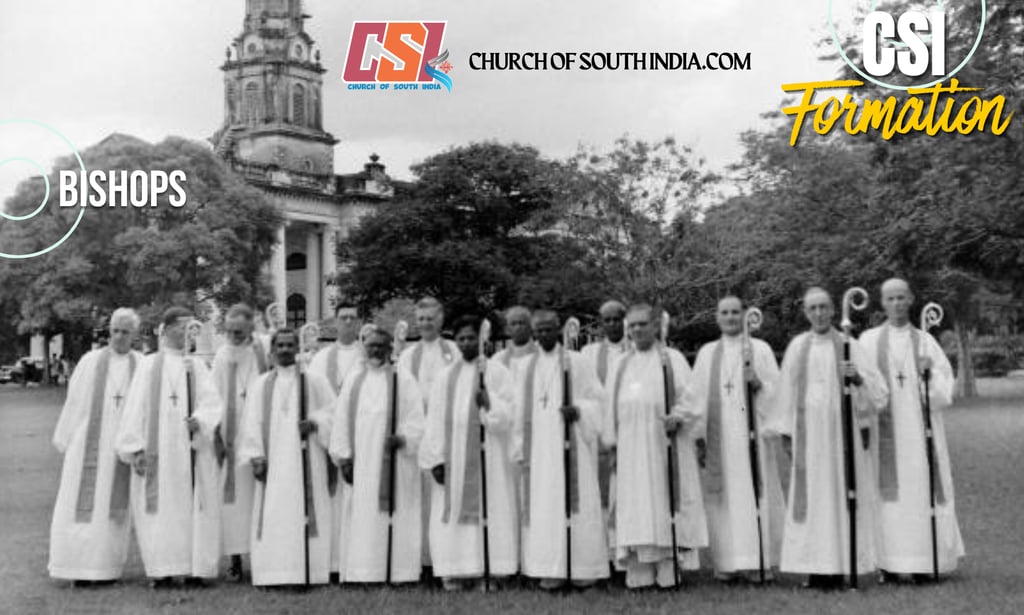
On 27 September 1947, only weeks after India became independent, Christians gathered at St George's Cathedral in Madras for a historic event. Christians belonging to Anglican, Methodist, Congregational, Presbyterian and Reformed traditions accepted one another and became one Church, the Church of South India.
The formal union brought together three major ecclesial bodies: the southern dioceses of the Church of India, Burma and Ceylon; the South India United Church, which had already brought together Presbyterian, Congregational and Reformed traditions; and the South Indian districts of the Methodist Church.
The Anglican participation included the dioceses of Madras, Travancore and Cochin, Tinnevelly and Dornakal. The South India United Church contributed the Madras, Madura, Malabar, Jaffna, Kannada, Telugu and Travancore councils, while Methodist districts including Madras, Trichinopoly, Hyderabad and Mysore also entered the union. Basel Mission churches and, subsequently, the Diocese of Nandyal further enriched the life of the united Church.
CSI therefore became historically significant because episcopal and non-episcopal Christians did not merely agree to cooperate. They entered into an organic union and sought to become one Church while respecting the spiritual gifts and traditions each had received.
1. Unity Builds (Nehemiah 2:17-20):
Jerusalem was not merely untidy. Its walls were broken and its gates burned. In the ancient world walls represented security, communal dignity and identity.
Nehemiah does not say, “I will rebuild.”
He says: “Come, let us rebuild the wall of Jerusalem.” (Nehemiah 2:17)
Then comes the beautiful response: “Let us start building!” (Nehemiah 2:18)
The Hebrew expression behind strengthening themselves for the work comes from ḥāzaq (חזק)—to strengthen, take courage, make firm.
The miracle begins before one stone is moved: individual concern becomes collective vocation.
CSI's founders faced another kind of wall i.e. the denominational walls inherited partly from European missionary history. Anglican, Presbyterian, Congregational and Methodist communities had genuine theological traditions, but they asked a more searching question: Must inherited differences permanently determine the shape of Christ's Church?
Nehemiah answers: there comes a time when God's people must stop explaining why the wall is divided and begin rebuilding together.
2. Unity Depends upon God (Psalm 28):
The Psalmist confesses: “The LORD is my strength and my shield.” (Psalm 28:7)
The Hebrew ʿēzer (עֵזֶר), “help,” reminds the Church that its security is ultimately not denominational strength, property, ancestry, numerical power or institutional prestige.
This matters because even a united church can slowly become preoccupied with preserving itself.
The Collect asks God to transform our “prejudices into powerful thoughts, words and actions to serve one another beyond boundaries.”
That is profound. Ecclesiastical unity cannot survive merely by constitutions. The heart must continually be converted.
3. Unity Rejects Personality Politics (1 Corinthians 3:1-15):
Corinth sounds disturbingly modern: “I belong to Paul.” “I belong to Apollos.”
Paul replies: “What then is Apollos? What is Paul? Servants through whom you came to believe.” (1 Corinthians 3:5)
Then: “For we are God's fellow workers.” (1 Corinthians 3:9)
The Greek word is synergoi (συνεργοί)—co-workers, people labouring together.
Paul does not erase different ministries. He puts them beneath one Lord: “I planted, Apollos watered, but God gave the growth.” (3:6).
That is perhaps CSI's most important lesson for 2026.
Our danger is no longer only saying, “I am Anglican,” “I am Methodist,” or “I am Presbyterian.” We can replace those labels with new ones:
“My diocese.”
“My linguistic group.”
“My bishop.”
“My region.”
“My congregation.”
The names change; Corinthianism survives.
Paul asks not, “Who owns this ministry?” but “Upon what foundation are you building?”
“For no one can lay any foundation other than the one that has been laid; that foundation is Jesus Christ.” (3:11).
4. Unity Exists for Service (Luke 9:10-17):
When thousands become hungry, the disciples say: “Send the crowd away.”
Jesus answers: “You give them something to eat.” (Luke 9:13).
The Greek dote (δότε) is an imperative: Give!
Jesus receives five loaves and two fish, blesses them, breaks them and gives them to the disciples.
Notice the movement: Christ receives → Christ blesses → disciples distribute → people are fed.
This is United in Service.
The Church does not unite merely so that bishops can share platforms or institutions can share constitutions. Unity is credible when hungry people are fed, lonely people welcomed, children educated, injustice confronted, creation protected and Christ proclaimed.
CSI's own mission statement describes the Church as God's servant, expressing solidarity with broken communities and pursuing unity, peace and reconciliation. World Council of Churches
II. Historical Developments After CSI Formation:
The union of 1947 continued and developed, but the history after union was not without disagreement. In 1964, a section of Christians identifying strongly with traditional Anglican identity separated from CSI and later became associated with what is known as the Anglican Church of India. This was a separation involving a section of Anglicans and should not be understood as the entire Anglican tradition withdrawing from CSI.
The Anglican heritage remained an important part of CSI itself. The Church of South India continued as a united Church bringing together Anglican, Methodist, Congregational, Presbyterian and Reformed inheritances, and CSI continue to belong to the Anglican Communion.
This history reminds us that Christian unity is not something achieved once in 1947 and then automatically preserved forever. Unity must be continually nurtured through humility, dialogue, forgiveness, mutual respect and a common commitment to Jesus Christ.
The history of CSI therefore gives us both a reason for thanksgiving and a continuing challenge. We honour those who crossed denominational boundaries in order to become one Church, but we must also ask whether our own generation is protecting that spirit of unity or creating new boundaries around language, region, culture, leadership and institutional identity.
III. CSI's Original Vision and the Diaspora Question:
As CSI members migrated to other parts of the world, particularly North America, congregations developed to provide worship, pastoral care and fellowship for people sharing the CSI tradition.
Such ministry can have an important purpose. Language, culture, familiar liturgy and community can help migrant families preserve their faith and pass it to succeeding generations. Acts 2 itself shows the Gospel being heard through many languages and cultures.
The deeper question, however, is how such structures relate to the original ecumenical vision of CSI.
The United States already has Episcopal, Methodist, Presbyterian, Congregational and Reformed churches belonging to the same broad Christian traditions from which CSI itself emerged. Therefore, the question for CSI in the diaspora should not simply be how to preserve a separate identity, but how that identity can contribute to the wider unity and mission of Christ's Church.
This does not mean that cultural identity must disappear. Christian unity is not uniformity. Malayalam, Tamil, Telugu, Kannada and other linguistic and cultural traditions can greatly enrich the wider Church.
But culture should become a bridge rather than a boundary.
The biblical question is therefore: Does our way of organizing the Church help Christians serve together, witness together and grow toward greater communion, or does it unintentionally rebuild some of the walls that earlier generations worked so courageously to overcome?
Jesus prayed: “That they may all be one.”
That prayer should remain before every generation of the Church.
IV. The Message for CSI Today:
· Nehemiah calls us to build together.
· The Psalmist calls us to depend upon God together.
· Paul reminds us that we are God's fellow workers, and warns us against building Christian identity around particular personalities or groups.
· Jesus tells His disciples, “You give them something to eat.”
· That is the heart of United in Service.
The greatest way to honour the founders of CSI is not simply to celebrate what happened in 1947. It is to continue the spiritual work they began.
We must therefore ask: What walls are we willing to remove today so that the world may see Christ more clearly?
The Church is not truly united simply because people carry the same membership card, follow the same constitution or belong to the same institution.
The Church becomes visibly united when people from different backgrounds receive grace from the same Christ and then use their different gifts together to serve God's world.
Our traditions are valuable.
Our languages are beautiful.
Our cultures are precious.
Our institutions have their place.
But Jesus Christ must remain greater than all of them.
May CSI continue to move from division to fellowship, from prejudice to love, from position to service, from boundaries to mission, and from “my church” toward the deeper confession that we belong to Christ and therefore belong to one another.
V. Let us Pray:
Triune God,
you rebuild ruined walls, strengthen your people,
and make strangers fellow workers in your kingdom.
Deliver us from every pride that says,
“I belong to Paul,” “I belong to Apollos,”
“this Church belongs to us.”
Lay again beneath us the one foundation, Jesus Christ.
Take the little we possess,
our traditions, languages, institutions, gifts and histories.
Bless them as Christ blessed the loaves.
Break what must be broken,
and multiply what can serve your people.
Where prejudice has created boundaries, create fellowship.
Where power has displaced service, restore humility.
Where culture has become exclusion, transform it into hospitality.
Where the Church is divided, make us courageous builders of communion.
Make your Church truly united in service,
until our unity points beyond ourselves
to the One who prayed that all may be one.
Through Jesus Christ our Lord. Amen.
VI. Original-Language Word Study:
Footnotes for Personal Study
1. Church of South India, “History of the Formation of the Church of South India”; National Council of Churches in India, “Constituent Bodies.” Church of South India
2. World Council of Churches, “Church of South India”; Anglican Communion, “The Church of South India (United).” World Council of Churches
3. World Council of Churches, “United and Uniting Churches.” World Council of Churches
4. CSI Diaspora Diocese, “History of CSI in North America” and “About Diaspora Diocese.” Csi Diaspora Diocese
Bibliography:
· Church of South India. The Constitution of the Church of South India. Chennai: CSI Synod.
· Newbigin, Lesslie. The Reunion of the Church: A Defence of the South India Scheme. London: SCM Press, 1948.
· World Council of Churches. “Church of South India.” Geneva: World Council of Churches.
· Anglican Communion. “The Church of South India (United).” London: Anglican Communion Office.
· Brown, Raymond E. The Gospel According to John XIII–XXI. Anchor Bible 29A. New York: Doubleday, 1970.
· Fee, Gordon D. The First Epistle to the Corinthians. NICNT. Grand Rapids: Eerdmans.
· Green, Joel B. The Gospel of Luke. NICNT. Grand Rapids: Eerdmans, 1997.
· Williamson, H. G. M. Ezra, Nehemiah. Word Biblical Commentary 16. Waco, TX: Word Books, 1985.

